Friday, September 14, 2012

Two Times Togo


Oh yea, I went to Togo…twice. 


The first trip I made to Togo, at the end of May, was to visit the daughter of one of my father’s old work colleagues, named Shelly, who works for Mercy Ships, a faith-based organization dedicated to bringing advanced medical procedures to high-need locations, where such medical technology is too expensive, or simply not available. Mercy Ships has essentially converted the lower level of an ocean liner, called the Africa Mercy, into a floating hospital, which at the time of my visit was docked in Lomé, Togo.

I have to make a brief interlude at this point, to tell the actual story of getting to Togo, part 1, because both journeys to Togo were quite an adventure.  So here is the story of getting to Togo the first time:

The trip from Accra to Aflao (the border city on the Ghana side), is just about 100mi, which in a country with good infrastructure should only take about 2 hrs, right? Hah. This journey took closer to five, considering the horrible traffic and poorly maintained roads (that sometimes bounce you so high they could cause a spontaneous abortion) but that wasn’t even the worst part. In general, getting a car for travel is pretty hit or miss. Sometimes you get a modern van with comfy seats and air-conditioning, and sometimes you get a van that shudders so much you wonder if it might crumble down around you.

This trip, the car was most definitely a miss. Let me paint you a word picture here.  The car that made the trip to Aflao looked like a standard Accra tro-tro—a construction van, circa 1980-something with five rows of seats, seating about four people per row. Add in about one bag per person, taking up the floor space, and 6 young children sitting on various laps, one of which was directly behind me, then I’ll raise you one crazy, can’t-seem –to-figure-out-how-to-drive-in-a -straight-line driver, and we’ve got ourselves a horse race. And it still gets worse.

So we start our journey out of Accra, and traffic is awful, as it always is. The driver keeps trying to weave in and out of traffic, slamming the brakes, then hitting the accelerator, slamming the brakes again…on and on and on. About 45mins of this goes by, and we are finally on the brink of getting out of traffic. You can see it, like the light of the end of the tunnel, reaching for that break in traffic, the driver guns the engine, just as the girl on the lap behind me proceeds to projectile vomit. All. Over. Me. So not only did I have to spend the next 4 hours squashed between two people with no foot room and no air flow, but I also had to spend it sitting in a pool of someone else’s vomit.

It was one of those situations where you just have to laugh. Murphy’s law. What else could have gone wrong? We finally made it to Aflao, I crossed the border, and Shelly was on the other side with her car, ready to whisk me away to the ship. Luckily, I was staying on the Africa Mercy, which has great water pressure and hot water. A shower never felt so good.


Anyway, now, anyone who knows me knows that I am not a huge fan of faith-based organizations. But I have to say, I was so impressed with what Mercy Ships is doing on the Africa Mercy. They spend about six months docked in ports all over Africa, providing cataract surgeries, fixing cleft palates, removing tumors, treating leprosy, providing dental care, and fixing physical abnormalities—just to name a few. And they’re all volunteers!

Now I know some cantankerous person somewhere is grumping about the Mercy Ship project not being sustainable enough, because it doesn’t fix any underlying problems in these countries that are causing the numerous health issues, but as someone wisely reminded me recently, projects are not about numbers and data, nor are they about saving the world; the meaning comes from the individual lives that are touched, or changed for the better. And seeing a person walk off the ship, able to truly smile for the first time because they have just had their cleft palate fixed, is nothing short of amazing. 

I have heard that 60 Minutes is doing story on the Africa Mercy in the near future, so if anyone is interested, watch out for that episode. I am not sure exactly sure when it’s airing, but the camera crew was due to arrive the week after I left.


Needless to say, I really enjoyed my weekend on the ship. I was able to tour the hospital, the control room, and even the school for the children who live on board. It was nice to get away from Accra for the weekend, and see what other organizations are doing—and also enjoy a hot shower, a comfortable bed, and Starbucks! Yes, they have a Starbucks on board. 

So, why, when I had just been to Togo, did I turn around and go back again at the end of the month? Well, my friend, I’ll level with you. One of the perks of being on the Africa Mercy is that all Mercy Ships employees are guaranteed entry in and out of Togo without needing to buy/have a visa. And when you’re a guest on the ship, they print you an official ID, so you can sign in and out of the ship during your stay. So, since the expiration date on my ID wasn’t until the end of June, what’s a girl to do? NOT take advantage of the fact that I can cross the border for free? I don’t think so. 

Thus begins the telling of the second journey to Togo. Don’t worry, no vomit this time.

The second time I went to Togo, the journey to Aflao was a bit more comfortable. Not only because of the absence of vomit, but the car my friend and I took was transporting a lot of construction materials, laid over the tops of some of the seats, blocking people from sitting there, which meant that we had the whole back seat to ourselves. Which never happens. 

We got off to a late start, and traffic, again, was despicable, but since there was space to breathe (and to move even!) in the car, I didn’t mind so much. Now when someone takes a destination car, like a car that is going to Aflao, they do not necessarily continue all the way to the final destination. So sometimes the car makes frequent stops, and people get off in various towns and villages along the way. In this particular car, we had a majority of those people. By the time we got half way through the journey, we were down to only 5 passengers. By the time we got three quarters of the way through the journey, we were down to only 3. And when the car was down to only three passengers, the driver decided it was not worth his gas to continue all the way to Aflao. Super.

So, the driver pulls over, hails a taxi driver friend, and tells the taxi to take us to Aflao, about thirty minutes further than the town we were in. It would have been fine, except the tro-tro driver took off without paying the taxi driver, which we didn’t figure out until half way to Aflao.

At this point, my friend and I were starving, tired, and grumpy. And refused to pay the taxi man, since we had already paid the tro-tro driver to take is all the way to Aflao. So the taxi driver turns around, goes back to the town, and starts looking for the tro-tro driver (apparently they are kind of friends?) to make him pay the difference. Luckily enough, we found the tro-tro driver, but he was not willing to pay for the rest of the journey. In situations like this, it’s really pays to have a Ghanaian buddy—especially one that is really good at threatening someone without actually threatening them. I was sitting in the car, so I am not sure exactly what was said, but the tro-tro driver ended up paying the rest of the money to the taxi driver, getting us safely to Aflao.

However, because of all the driving back and forth nonsense, we got to Aflao just as the border was closing, and were forced to stay in Aflao for the night. To date, that hotel was the grossest place I have ever stayed: cobwebs and dirt everywhere. But, it was the equivalent of $5 for one night, so I guess you get what you pay for.

And then FINALLY, we got to Togo! 


Now I could probably go on and on about how awesome Togo is, but this post is already getting to be too long, so I will keep it to the highlights. First, there is significantly less traffic in Lome than there is in Accra, partially because Lome is just smaller and less populated, but also because more people travel by motorbike than they do by car. 


Second, its francophone. Which means more fun for me for two main reasons! A. because I get to practice my French, and B. because FINALLY  I am the one who understands, not my friend, and can pick and choose what to translate, which happens to me allllll the time in Accra. My friends love prattling away in their local languages and only giving me minimal translations. So--Justice. 

And lastly, the VOODOO MARKET, which it think was my favorite place that we visited in Lomé. This particular market was a voodoo fetish market, which means that they sell charms, totems, and things--for protection while travelling, making someone fall in love, protection from spirits--that sort of thing. There are also fetish priests who sometimes perform ceremonies, to drive away illnesses that are caused by spirits. Now, I will say, that this market was a liiiiiiiiiiiiittle kitschy, most likely because there is more tourist traffic through the capital. But it was still very cool to visit. 

The voodoo itself is an interesting practice though. Depending on what is ailing you, the fetish priest selects from his store of dried and cured animals (cured in a special liquid that keeps them from rotting), which can be burnt as a sacrifice, or ground up, added together, and turned into a medicine, based on the "prescription" from the fetish priest. 

And judging by the display, there are a multitude of different dried animal combinations. They have everything from cheetah to chimp to chameleon. Skulls and skins alike. 


 Below is the area where they hold ceremonies and sacrificial burnings. Our guide was very excited to be in the picture :)
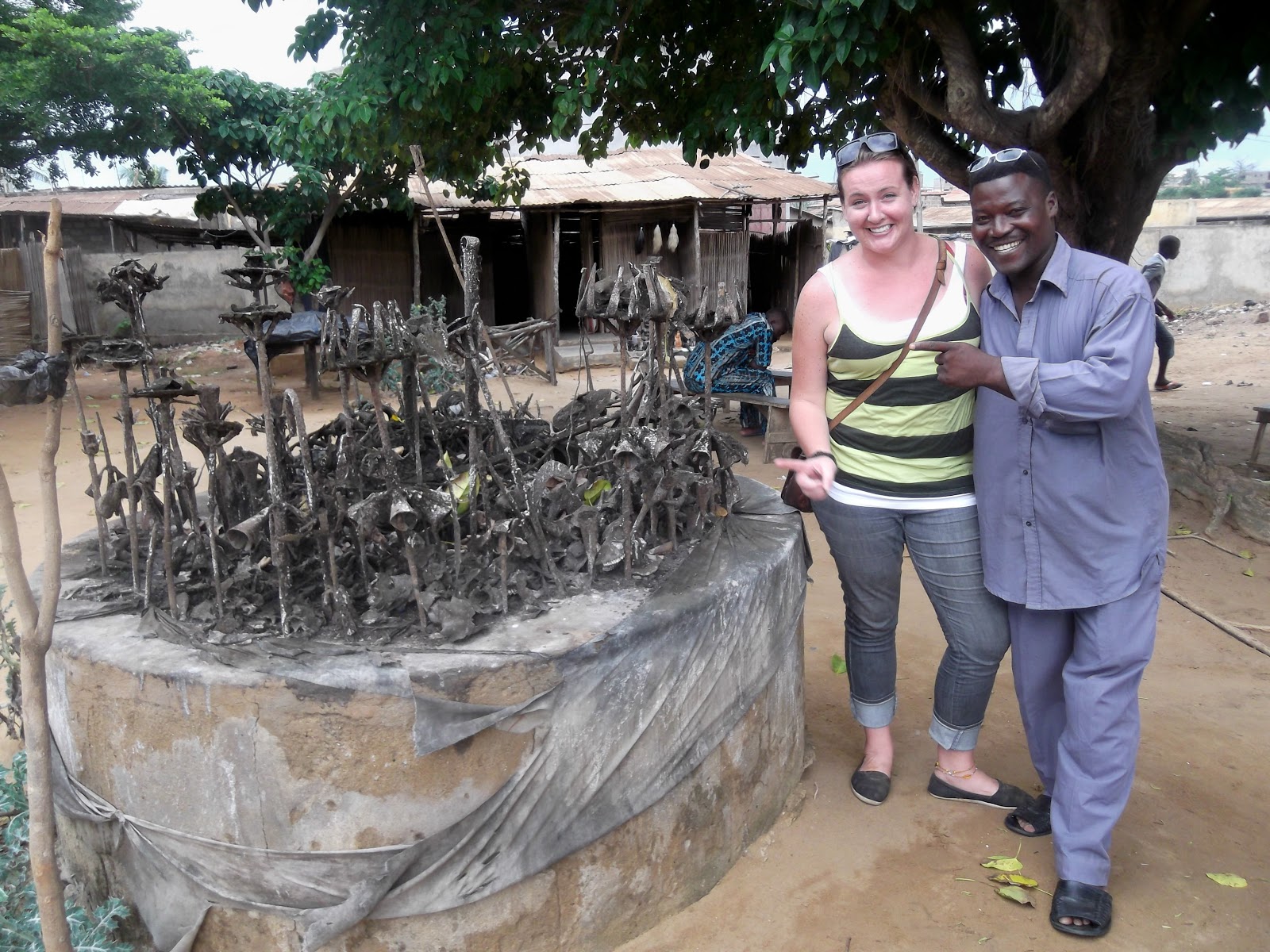
Although the market seemed to be mostly geared towards tourists, there really is a significant portion of the population in Togo, I think about half, that actually practices indigenous religions, like voodoo, some 2.5 million people. It makes me wonder what more genuine voodoo looks like. I really want to travel out into villages, to see...maybe that can be on my third trip to Togo! Now, how can I get in again without a visa...

Until next time! 


Friday, June 8, 2012

Chale Wote

Wow. It’s been over a month since the last update. But really, when you think about it, at this point my life has fallen into the basic routine that everyone follows everywhere—work-eat-sleep-repeat. So unless something breaks me out of that routine, or I have some sort of cultural run-in that makes me look like a fool, I don’t really have anything to write about. Right?

 Don’t get your hopes up though; I don’t look like a fool in this story…well…at least not any more than usual.

 As I get better acclimated with Accra, and all of its neighborhoods, I am starting to find the places that I really enjoy. For example, I love going to Nima, even though it’s very far from where I live, because the majority of the population is Hausa, which is great language practice. It also makes me feel like less of a failure because I really have not learned much of the popular languages in Ghana, like Twi or Ga. And, as an added bonus, if I go there for work, I can rub it in my colleagues faces that understand and they don’t (for once). Sounds spiteful, I know, but around the office they have started pretending to talk about me in Ga, just to get under my skin.

 But my favorite neighborhood, so far at least, is James Town. If Accra was a microcosm of the US, James Town would be NYC. There’s ALWAYS something fun going on. Whether it’s a festival, party, or just an ad hoc gathering, James Town is the neighborhood that never sleeps. It’s also one of the oldest neighborhoods in Accra, and it used to be the main harbor before Tema harbor was constructed, so there is a lot of history to it as well.
 
Let’s do history first!

 As far as the historical sites go, the lighthouse is probably the coolest. Built by the British during their colonial rule, you can go all the way to the top and get a great view of Accra. There are also two forts in the vicinity, James Fort and Ussher fort, but Ussher Fort is the only one that allows visitors. It also happens to be where Kwame Nkrumah, Ghana’s first President, was held captive. There’s been talk of Ussher fort being converted into a museum, but that has yet to happen.


Because James Town used to me the main harbor, there are some remnants of the slave trade as well. Most slaves from Ghana passed through Elmina, which is an island West of Accra, but some slaves were transported from the harbor in James Town. One of my friends has told me that there are underground tunnels connecting Ussher Fort with the harbor, used to transport slaves from the cells to the boats, but I have yet to see any of those. The harbor itself is still very active, not so much for shipping anymore, but for fisherman and crabbers! It’s pretty fun to walk down the breakwater and see all of the fisherman and their giant nets. The boats they use are these little pirogues… I have no idea how they don’t capsize out in the choppy ocean, but somehow they manage.


Now for the festival!

I think the pictures can pretty much speak for themselves, but the Chale Wote Street Art festival is a combination of visual art, fashion, music, and street performance—including some very impressive acrobatics and different types of dance. Needless to say, it was a lot of fun.


Looking forward to seeing everyone in July!! Bye for now.

Wednesday, May 23, 2012

Friday, April 6, 2012

Mawage. Mawage is wot bwings us togeder tooday..

(Sorry if you're all tired of my weird movie references)

A few weeks ago, I had the privilege of attending a wedding ceremony. I was invited by one of my coworkers, who is a member of the congregation of the church where the wedding was held, and also plays drums in the church band that played at the wedding. I didn’t know the couple personally, but just like at the funeral, it really doesn’t matter. That’s one thing I love about African culture—it’s always, “the more the merrier.”


Now, I’m sure there is a lot of variance in wedding ceremonies, but the wedding I went to happened to be Pentecost Revival. Maybe I’ll get to go to another wedding while I’m here so I can compare. As for this wedding, the decorations were themed as white and gold, with balloons and canopies, and flowers everywhere…it was quite beautiful. There was also a red carpet running down the aisle, making the bride feel like a celebrity, I’m sure.


The wedding ceremony started with the groom and best man walking in, and sitting underneath a canopy, set at the front of the church. Then, the traditional processional starts, with the flower girl (who was the CUTEST ever), maid of honor (who was the only bridesmaid) and then the bride and her father. The father walked the bride up to the canopy, and then sat her down next to the groom in the front, with the maid of honor sitting next to the best man behind them.


After the opening prayer, the four officiating ministers (yes, four!) were introduced, and each of them said small words of congratulations to the couple. Then, there was a hymn and offertory made to the couple. Now, when I think of hymn and offertory, I think of people passing around a bowl while something like, to god be the glory ringing in the background.


No, no, no. Hymn and offertory in this church was much more fun than that. Everyone got up, dancing and singing, and formed a circle around the couple seated at the front of the church. As you dance around the couple, there was a small box on the right side where people dropped in their offering. I have a great video of this, but because my internet modem is stupid, I can’t get it to upload. But everyone was so joyful and energetic; it was really a lot of fun to watch. Also, they call the choir the “praise team.” :D


Once everyone has made their offering, the ceremony continued with the couple taking their vows and exchanging rings, followed by another bout of dancing and singing. Note: I did not go stand in the front of the church and shove my camera in the couples’ face. My coworker took my camera and was taking pictures from the band’s vantage point. I’m not that obnoxious.


Next on the docket was the sermon, which admittedly is going to be a little difficult for me to write about in a neutral fashion. The sermon started out with the lead pastor reading out divorce statistics in Ghana from each year since 2003, most of which sat around 55%. He then made the claim that the reason divorce rates are so high is because women are not “submitting to their husbands,” as the bible teaches them to. He spent an entire half hour talking about how, and this is almost a direct quote, “even if the fault is on the man, the woman must submit and say I’m sorry. Even if it is the woman who makes all the money and puts food on the table, she must submit and say I’m sorry.”


Tangent time:

Now, I fully admit that I have a huge cultural bias. And I’m not going to talk much about this sermon, but I will say that I have never had to work so hard to keep my facial expression neutral. I will also say, that this sermon was well received by everyone else in the congregation. Women were even cheering after some of the things the pastor said, which I admit had me a bit confused. But you know, so many things are hard to understand on the outside looking in. For example, I would say most western women see traditional Muslim garb as a sign of repression, but many women in Middle Eastern countries prefer to wear burkas because they say it keeps men from ogling them in public, and it adds a level of intimacy with their husbands.

Because my job has me working only with men, I don’t really have a good perception of women in Ghana. As I am nosy and curious, I have talked with a lot of men about relationships, and most of them tell me that it is the woman’s job to do the cooking and the cleaning. I had one man even tell me that he married his wife just so he would have someone to cook for him. Another friend told me that if family sees that a wife is not taking care of the husband, like if the husband is seen cooking or something, the family can even step in and break up the marriage. On the flip-side, if a husband is seen going to the market, he is seen as being “cheap” or “stingy,” because when he gives his wife money for shopping, she can usually pocket what’s leftover. Of the few women I have talked to, some have told me that they like “taking care” of their husbands; because they give their wives money/gifts and make them feel protected.

This sermon, consequently, has also sparked numerous religious and gender equality debates between me and my coworkers, but that’s another story entirely.

In conclusion of this tangent, I do not understand a lot of things about relationships and marriage. But I do understand that social pressure is ENORMOUS. People are always in each other’s lives, usually in a good way. Also I need to make a greater effort to make female friends, I think.


Anyway, back to the marriage ceremony. After the sermon, another offertory was made, this time to the church, and was accompanied by just as much singing and dancing. Listed on the program, the hymn during the second offertory was supposed to be Oh! Perfect Love, which I thought was funny considering that that song is a wedding tradition in my family, but it wasn’t actually sung.


(How cute are they?!)

After the second offertory, the couple was presented with their marriage certificate; there was a closing prayer, and then the couple and wedding party recessed out (hmm is that the right term? It sounds awkward.) The couple then stood just outside of the church, so everyone could congratulate them on their way out, which was the completion of the ceremony part of the wedding. In between the ceremony and reception, the wedding party went to a garden across the street to take photos.


I did not stay for a lot of the reception, but the part I was there for was very similar to weddings I have been to in the US. There’s lot of drinks (nonalcoholic at this particular reception), and food. Music, dance, friends and family of the couple give toasts, the cake is cut, yadda yadda yadda.


Despite the sermon, it was a lovely wedding and I’m very glad I went. Some of my favorite experiences come from situations where I find myself with little understanding. Gender roles and religion are tough topics in every culture, and the more I observe in other places, the more I think about their implications in my own culture. Hell, just look at some of the things Rick Santorum says, and he’s made it this far in the run for President! But that’s a whole other can o’ worms, so I think I’ll stop here.

Happy Easter, or Passover, or weekend—which ever you choose to celebrate!

Sunday, March 25, 2012

My Ghanaian Kitchen

Because food is such an important part of culture, I had been asking some of my friends to teach me how to make some local dishes. Now, if you remember from previous entries, the majority of Ghanaian food, like Kenkey, Banku, and Fufu, revolves around doughy-pastey balls (and please do not take that description out of context). But to make those dishes, it requires a lot of grinding up corn and cassava, pounding the paste, baking the dough…basically, it’s a lot of work. And for the most part, my idea of home cooking is throwing whatever I have into a skillet and mixing it with pasta. Ba-da-boom, dinner! In short, my friend and I decided to try a local dish that is a little more along my dump-stir repeat philosophy.


SO we made Jollof rice!


What’s Jollof rice? Glad you asked! Jollof rice is a spicy tomato-based rice dish, mixed with vegetables, and often times served with fried chicken or beef. I wanted to make it vegetarian, mostly because I’m afraid of raw meat, but after a series of small arguments, my friend refused (“meat, madam, meat!”), so in this instance, we made it with beef.


Here’s what you’ll need!


-5 tomatoes
-2 carrots
-2 yellow onions
-1 green pepper
-1 can tomato paste
-1 bag super-secret Ghanaian spice
-raw beef (grossssss)
-4 cups of rice
-salt
-cooking oil
-1 fire extinguisher (especially if I’m involved)
-2 packets of bullion
-water
-1 helpful Ghanaian who actually knows what’s going on


Step 1
Wash your hands. You're dirty.


Step 2
Cover the bottom of a large pan with cooking oil. Chop one of the onions and dump it into the pot to simmer.


Step 2
Have someone other than me cook the beef.


Step 3
Chop the tomatoes, and set them aside. Chop the green pepper and carrots. Cut the other onion into large rings.


Step 4
Add the full can of tomato paste into the pot. Saying “bam” whist you do so. I made my friend say “bam” every time he added something…even though I’m pretty sure he’s never seen Emeril…


Step 5
Add the freshly chopped tomatoes and allow to simmer for..oh, let’s say 5 mins. Clearly I know what I’m talking about.


Step 6
Add the green pepper, carrots, and onion rings.


Step 7
Add cooked beef, bullion, and rice and water in the appropriate ratio. I usually add to much water and end up with mushy rice :P


Step 8
Allow to simmer, stirring occasionally, adding super-secret spice to taste, until water is no more.


Step 9
Eat your yummy Jollof rice.


And last but not least…

Step 10
Make your helpful Ghanaian do the dishes…I mean…he offered…I'm not gonna say no :D


Now hopefully I will be able to make this on my own. If I can manage to sneak some spices through customs, I will be making this when I’m home in July.

Who wants to do the dishes for me??

Monday, March 12, 2012

Ghana Turns 55!

On March 6, 1957, Ghana became a free country; not only a free country, but the FIRST former colony to be freed in Africa. Fifty-five years. That’s really not a long time at all. When you learn about colonialism in school, it seems like something that happened so long ago. (It is history, after all.) So sometimes I forget how recent all of Ghana’s history really is.

Just for fun, let’s travel back in time for a second..er...paragraph, to when America was turning 55. This puts us at what, 1831? I’m a little sleepy for math. So 55 years after the US becomes independent from Britain (just like Ghana), we were a mere 24 states, predominantly a rural country, and Mr. Andrew Jackson was our President. Darwin began his voyage on board HMS Beagle. Nat Turner was captured, arrested, and hung for inciting bloody slave revolts. Oil lamps were the most popular form of lighting, as gas lamps were only available in cities. Corn husking and, quilting-bees were the height of entertainment, but of course sewing machines did not exist at this point. And the price of pantaloons went up ten-fold! (Ok that last one I made up...)

I’m not necessarily trying to make a point with any of this, but I think it adds an interesting perspective. This is what happens when I’m trying to blog whilst I’m really just too tired to do so.

Anyway, back to Ghana turning 55.


Like most independence celebrations, one of the main activities is a parade. Fortunately I have one co-worker who was willing to go with me. So, at seven in the morning, we trudged down to Independence Square for the annual parade. The parade itself doesn’t start until nine, but in order to get a seat, you’ve got to get there early.

First on the list of festivities is the processional is every branch of the armed forces imaginable marching through and lining up in the square, followed by groups of students from a select few Accra schools, all while the marching band plays in the background.


After everyone is lined up, a motorcade of vehicles brings in major political figures, like the former President, the Vice President, and finally, the President himself. After they are all seated in the front, the band plays some more, marches around, and does some fancy baton twirling. One of the conductors dropped his baton, causing the whole crowd to gasp.

Then everyone rises while national anthem is played. From there, the President gives his keynote address. I honestly don’t know what the President’s speech was about. He is very soft spoken to begin with, but, according to rumors, he also has throat cancer, which makes him even harder to understand. When the President finished his speech, he got into the back of an open vehicle and drove through the lines of people who paraded in, to end up in the front of the square, where he got down and lit the goblet of fire. (Clearly I don’t know what it’s actually called.) But it is supposed to represent the flame/spirit of Ghana’s independence.


After the President is safely back in his seat, the “special forces” march through, which are basically the front lines of the army and navy. Side note—the navy has a sense of humor. Its hard to tell in the pictures, but they have snorkel masks on their heads, and flippers attached to their backpacks. Once the special forces are lined up, all of the vehicles of the various armed forces drive through the square: tanks, bazooka-looking cars, fire engines..etc.


I asked my coworker why there’s so much focus on the military, and he said that Independence Day is a chance for Ghana to show the rest of the world that they are capable of handling their own affairs. He also pointed to a number of large ships just off the coast of the square, who were supposedly protecting Ghana from being bombed? :/ My coworker told me that recently, Ghana recognized Kosovo as an independent state, which made Serbia angry. But personally I think Serbia bombing Ghana is extremely unlikely. I need to start following Ghanaian newspapers…

Ok, time for a horse tangent, because I was dying of laughter at several points during the ceremony because the horses were ridiculous. There were three horses involved in the ceremony. One of them, who was stationed next to a line of soldiers, kept backing up into the line of people. This happened several times, before someone was commissioned to come hold the horse still. About mid-way through the ceremony, they switched that one horse out for another, who did stand quietly, but also refused to move forward with the soldiers where they started marching again. The poor same guy who had to hold the last horse had to come out and chase the new horse to make it move. It was hilarious! I had summer camp flashbacks. Ghana needs a new horse trainer.


But back to the ceremony. After the armored vehicles make their rounds, canons are fired from behind the Independence arch, located at the top of the square. The everyone who marched in, had to march back out again. Two things I found particularly interesting: 1.Despite all of the police, army, navy..etc, present and marching, there was not a single security checkpoint to get in. Even though the president was there. 2. More people cheered for the former President than they did for the current President.

Just to prove I was there :)


After the morning festivities, since it’s a national holiday and no one goes to work, most people go to the beach to relax. I went to the beach for a while, but I have some friends who are part of a theater group, and they were putting on a performance in honor of independence day, so I went to that in the evening. The show was called, “Nkrumah in Love,” Nkrumah being the first President of Ghana. (I think the title is a play-off of “Shakespeare in Love”, but I’ve never seen that movie so I have no idea if the entire show was a parallel.)

The play was a satirical representation of the life of Kwame Nkrumah, starting with his declaring Ghana a free country at the Accra Polo Grounds. Most of the humor comes from the fact that everyone seems to have a different opinion of Nkrumah, which was also true in real life. Was he a liberator? An intellectual? A pan-African leader? A socialist? The show continually contrasted Nkrumah with people from different stratas of society, like the British nationals, the educated “elite,” the common people, and the military. Everyone did a great job--It was a pretty funny show.


Ok, I think this post is getting to be too long, and I am sufficiently tired. Quarterly training starts tomorrow, so I really need to get some sleep!