Saturday, February 23, 2013

Going on Tour


For all of you that I was not able to see during my all-too-brief visit to the US, I hope you had a merry Christmas, or happy Chanukah, or an awesome Festivus for the Restivus! (Does anyone actually know people who celebrate Kwanzaa? Cuz I don’t.) And of course, a Happy New Year!

I’ve been back in Ghana for about a month now, and have fallen steadily back into the pattern of daily life. Some quick little updates before I dive into the juicy stuff—we have two new volunteers now: one a student from Canada, the other a nurse from Boston, and I have to say, it is not only nice to have other expats around, but it’s even nicer to have other females around for a change. Not that I don’t love my co-workers, but it will be nice to have voices to back me up when the whole, “women belong making babies or dinner” argument inevitably surfaces again.

Another short update: the grants funding both projects I’m working on in Ghana are scheduled to finish up this summer, so something’s going change in the next few months. Stand by.

So. I thought we’d kick off the New Year (yes, I know its February, but this is the premier post of 2013) with a little work talk, and wrap it up with a little fun talk. Not that work isn’t fun, but, you know, all work and no play make readers fall asleep...or something like that.

Part One
To begin:  The USAID grant I work under is a three year project, and each year of this project, we are supposed to expand programming into new regions/cities/villages/whatever. So in the first year we were only working in Accra, in the second year we expanded into two major cities in the Volta region, and now, in year three, we expanded into five new villages in the Volta region. It’s really quite exciting because these villages have not really had our type of program before.

In a community driven project, you need to get the community involved (obviously). And one challenge that we have faced in other places, is really getting our name out there, other than within our small target population. To address this problem, one of my coworkers and I had an idea to combine interactive theatre performances, to lure in the crowd, with free HIV testing and health screenings, to really show the community what we (sort of) do. Through some interesting brainstorming sessions, we finally came up with a “going on tour” concept, complete with tour bus, health equipment, t-shirts, roadies and groupies. Ok, maybe not groupies.

But in order to start working in a new place, there are certain protocols that need to be followed. (Especially in Ghana, where they looooooove their bureaucracy and rigmarole protocols). So late last year, our project coordinator in the Volta region and I went around, meeting with the local assemblies and clinics in each village, to get them onboard and involved in our project. It was a long process, and a nightmarish cornucopia of logistics, but two weeks ago we pulled off the grand village tour of 2013!

Some of our actors on the tour bus

It was quite an adventure—six theatre performers, three office workers, our volunteer nurse, and me. We hit five villages in five days, which may not sound that impressive, but if you could only see the roads that connect these villages, you would understand.

So here’s an outline of our event:

In each of the villages, we set up a table and small screen for HIV testing in busy parts of town—markets, stations, squares…etc, the idea being that we wanted to be in the place that would get us the most attention (youngest child syndrome for NGOs..) After setting up, the theatre performers start one of the numerous silly games that they play, usually in a circle involving some sort of song or dance, to attract attention. After enough people have gathered, the theatre facilitator explains that they are about to put on a small performance, and then introduces the main character. Then the performance begins!

The storyline we chose for these events was a story showing HIV stigma and discrimination. It follows a young girl, who completes Junior high school, and wants to continue on to Senior high school, but her father is unable to pay her school fees. After visiting a few relatives who are also unable to pay, the young girl goes to one of her school mates, to see if she can help. The school mate tells her about a man who has been helping a lot of young girls pay their school fees, and offers to call the man and introduce them.

Protagonist in the center

When the main character goes to visit this man, he makes it appear like he is not going to help her with schools fees, unless she “helps” him as well. (What’s our poor protagonist to do?!) In the end, she succumbs, and soon after discovers that she contracted HIV.

Being seduced!

After learning her HIV status, the main character confides in her father, who throws her out of the house. Left with nowhere to go, she returns to her schoolmate that introduced her to the man, but after the schoolmate learns that the protagonist is HIV positive, she rejects her as well.

Angry Daddy!


Begging :(


The performance ends with the protagonist on her knees, begging the audience to help her. It’s a sad story, and unfortunately, the dilemma the protagonist faces is not uncommon in Ghana. Transactional sex is pretty normal, and many families struggle to pay school fees for their children.

Anyway, following the performance, the facilitator comes back out to lead a discussion on HIV stigma, modes of transmission, and the importance of learning your status—a perfect segue into the next phase of our event—HIV testing and BP screening!


Volunteer nurse checking BP


Each event was set up a little differently, but for the most part, we had a nurse from the village clinic conducting the HIV tests, and our volunteer nurse screening for high blood pressure. But in some places, people were only interested in HIV tests, so both nurses were doing HIV testing. Anyway, while people were waiting for their turn, we had condom demonstrations, STI talks, and passed out lots and lots of reading materials. 


Condom demonstration
'


STI Discussion using real pictures of STIs...I'd post some, but they would give you nightmares


And although there were some hiccups along the way, which is to be expected since this was our first time doing something like this; all in all, the events were very successful. We even had to turn people away at times because we didn’t have enough HIV test kits to meet demand! It was pretty encouraging. Hopefully we can do a follow up tour soon. And maybe this time, we WILL have groupies.

The crew! 


Part Two

The Volta region of Ghana is one of the most beautiful (in my opinion). It has Lake Volta, the Volta River, mountains, MONKEYS, and a whole bunch of other natural attractions. But even though I have been in Ghana for a significant amount of time, I have not seen it all! While time is a big challenge, the biggest challenge is finding someone to go with. Most Ghanaians have either been before, have no interest, or have some other reason for not being able to go. This is why I am happy to have new volunteers! Because they haven’t been places, they want to go, and they usually only have a few months to try and get everywhere they want to.

So, after our week long village tour in the Volta region, the volunteer nurse and I stayed the weekend, and did some sightseeing—first to Wli Falls, and then back to the monkey sanctuary!

This sign make me giggle..bats and butterflies are the only creatures worth specifying! 

Wli Falls, the highest waterfall in Ghana, gets its water from the Agumatsa River. To get there is a fun hike, which you can either take one hour to the lower falls, or three hours to the upper falls. Unfortunately we got there too late to do the hike to the upper falls, but it was still a really nice walk and you have to cross a bunch of log bridges that take you over the zig-zag river before getting to the falls themselves.
I think the pictures pretty much speak for themselves.


The path to the falls


Giant tree


One of many log bridges

The falls!


 And, even though I was not planning on it, we did end up swimming under the falls. But my friend had to wait a bit before we could go, not because I was scared, but because when we first got to the falls there was a big group of students there, and I was not willing to be the subject of camera phone pictures and videos, wading across the rocks in my underwear! And despite many stereotypes of Africa, it was freeeeeeeeeezing!


You can see us way in the distance. Our guide was not the best photographer, haha

And although I did go to the monkey sanctuary again, my camera was dead at that point, so I wil have to get the pictures from my friend before posting about that leg of the adventure :)

Wednesday, December 5, 2012

The Infamous Sign

This sign is posted near one of my favorite bars. It cracks me up every time I see it, so I thought I should finally take a picture, and share it with the blogosphere...


I do feel bad for anyone who takes this seriously, and tries to solve some of these problems through this woman. I should call the number and ask her what her success rate is...

Sunday, November 25, 2012

Microwave Thanksgiving

Thanksgiving in foreign countries is always an interesting experience, and I'm never quite sure what to do. In Niger, each of us planned beforehand to bring something to make as a potluck--but in Ghana, I'm not here with colleagues to plan ahead with. Of course you have those expat gatherings, usually organized by the Embassy, where you can find all the right food and blah blah blah. But I think that's boring.

I've learned so much about Ghanaian culture, traditions, and holidays, that I wanted to try and bring an America tradition to my friends here. But, much easier said than done for a few key reasons: 1) I don't have an oven..or a kitchen, for that matter. I have a microwave. 2) Cooked Turkey is IMPOSSIBLE to find. 3) Power outages are unpredictable and spiteful.

So, bearing those three key factors in mind, I set out to create a make shift Thanksgiving imitation, to try and show my friends what this American holiday is like. First step was finding the food.

My initial idea was to try and find the sides and main dish already cooked, since I knew my ability to actually prepare food was limited. But after searching high and low for cooked turkey, I decided that oven roasted chicken would have to suffice. The mashed potatoes also proved tricky. I even went to the KFC to try and find pre-made mashed potatoes -but they didn't even have them on the menu! How can you have a KFC with no mashed potatoes, I ask you?! Anyway, after considering several options, such as mashing up french fries, or boiling potatoes in my electric water heater, I decided that the easiest option would be to buy frozen mashed potatoes and cook them in the microwave. However, I couldn't even find plain mashed potatoes! The store had frozen mashed potatoes blended with sprouts, or frozen mashed potatoes blended with spinach. Both bizarre--but I decided that the spinach combo would be less weird.

But at that same grocery store, I also found instant stuffing, instant gravy, and frozen peas and carrots, making my meal mostly complete, and thus, microwave Thanksgiving was born!

I called up a few friends, commissioned one of them to bring some wine, bought all of my ingredients, and set out to create my feast. However, just as I walked through the door of my apartment, the lights dramatically went off! Not only did this ruin  my Thanksgiving plans, but, as anyone who was at my parents' house knows, it made the traditional Thanksgiving day skype call a bit of a challenge as well. Fortunately I have a simcard powered modem, so I could access internet, but visibility was a bit of an issue on my end, even after lighting several candles. But it was still fun to chat, and get to be "part" of the holiday with family.

But back to microwave Thanksgiving! The good thing about having all frozen/instant food, is that it is inherently made to last. Which means that while microwave Thanksgiving had to be postponed, none of the food was ruined.

So last night, I gathered some friends, made my microwave earn its keep, and American Thanksgiving was celebrated! The chicken was great (obviously because I didn't make it), and the rest of the food was saved by salt, butter, and the gravy. Gravy makes the meal, in my opinion :)


And while I assured my friends that real Thanksgiving food tastes much better than what they were eating, we had a lot of fun, anyway.

We got pretty silly towards the end.


I hope everyone had a safe, and delicious Thanksgiving!!

Thursday, November 1, 2012

It's a Ghana-versairy!


First things first, I hope everyone had a safe and happy Halloween, full of ghosties and goblins and candy corn cavities. I actually haven’t been able to celebrate Halloween for the past two years, sort of miss it.

So. I have officially been in Ghana a year now, well, as of October 16, I had been here a year. I'm a bit late on the anniversary post—whoops—but obla di ohbla da…

Anyway, when I first took this job, I had no idea that I would be here this long. My original contract, if you remember, was only for six months. But one thing led to another, and I’ve found myself still here. And since I am here because of the job, I figured the belated anniversary post, should be semi-devoted to what I am actually here for, not just the random musings of a wanderer.

Now I haven’t really written about work much, but we've started a new project here, and while it’s a very small pilot, I am actually quite proud of what we've been able to accomplish in a short amount of time, especially considering the numerous hiccups along the way.

To start from the beginning, my organization was awarded a small $5000 grant back in February from the AIDS Foundation of Chicago, to open a small free STI/HIV clinic for most-at-risk populations in Accra. Full disclosure, I had nothing to do with that proposal; it was submitted before I was even hired. So I can’t take any credit for winning the money, however, because this project is separate from our local partner in Ghana, and I am the only staff member here, I can take credit for all spending of the money…basically I got the fun part :D

But let me tell you, it did NOT start out fun. Just think to yourself for a moment, what would you do if someone just handed you some money, and said go start a clinic? Where would you start? Not to make my story grandiose, but I imagine Noah felt something similar when God asked him to build an Ark (wait, you want me to whaaaaat?) But, sorry Noah, in this day and age, you can google “how to build a boat” and I’m sure you can find step by step instructions. Pretty sure if you google, “how to start a clinic in Ghana,” that’s not going to be the case. Actually, I better go check that before I make that claim…ok, no, it’s not there. Hah.

Anyway, before I could even think about how to start the project, I had to first figure out how to just get the money to Ghana in the first place—which should have been the easiest part of the whole process, right? I only needed to open up an account, because my organization one set up in Ghana, since we work through our local partner.

Now, I’m not going to go all the way into this saga, but in a nutshell, since APRIL, I have gone back and forth to the bank at least ten times, and every time I go, I ask, is this REALLY the last thing you need from me, but then they tell me I need to get some new document from headquarters, which again, shouldn’t be that hard, except they kept making me change the signing mandate on the account and, oh wait, everything needs to be original signed copies from Chicago, and oh wait, now we need documentation from every person who was ever slightly affiliated with your organization to submit a scan of their driver’s license.  And after everything, months and months of collecting documents, they turn around again and tell me that everything I had submitted needs to be notarized and re-submitted.  (Oh by the way, all of this grant money needs to be spent by December. So there was a time crunch as well.)

Never have I ever met a bank so unwilling to take money. Either they’re just the worst bank in existence, or it just goes to show you how much money gets laundered in Ghana.

Long story short, I do NOT have a business account in Ghana. One of my coworkers from HQ, who was flying though Ghana, had to bring me cash for this project. So first challenge, completed.

Next, building the clinic space. For this part I got a bit lucky, because our office is really a three bedroom house, so there is a garage space attached to the side (including a private bathroom) which had previously been used as an internet café, so there were wooden partitions already installed. All it really needed was to extend the partitions a bit closer to the ceiling, to replace the flooring, and to hang privacy curtains around the perimeter. All of which took a surprisingly short amount of time.


After that, I was tasked with finding all of the medical equipment, which was a lot easier than I thought it would be. I only had to go to two different medical suppliers to get everything I needed. Next I had to procure STI drugs, which again, was a lot easier than I expected. I would have thought that you would need some sort of license or accreditation, or SOME sort of proof that I wasn’t going to, I dunno, sell the drugs to kids, to buy in bulk from a wholesale pharmacy, but I was able to just walk in and walk out with $600 worth of drugs.

Actually, the most challenging thing to buy was a bit of a surprise. Not because it was hard to find, but because there are just different names for things here. Believe it or not, it was a trashcan. It’s a pretty funny tangent.

--I go to this little roadside store, because I’m trying to cut down on costs, and I ask the lady if she sells trashcans. She gives me a blank stare for a minute, and says, “I don’t know what that is.” So I try again, “you know, a trashcan, or garbage can.” Again, the woman looks at me, and says, “Garbage can?” I paused for a second, trying to think of what word they might use. A little cartoon light bulb popped above my head as I thought, ok, Ghana was a British colony, what do the British call a trashcan? So I tried again, “I’m looking to buy a rubbish bin.”  

Nope, still giving me a blank stare. At this point I got a bit perplexed. How many names can there be for a trashcan? I wracked my brain, and tried one last time, “I need to buy a wastebasket.” Nope. Strike three. We stared at each other for a minute, and decided that maybe I should try and define the object, rather than name the object itself. So I say, “I need to buy something that I can use to thrown things away after I am done with them.” The woman laughs at me, and says, “so you want to buy a dustbin.” And even though out loud I said yes, in my head I was thinking, “But I ain’t going to be putting dust in it, lady…

It just goes to show you that even if you speak the same language, you might not speak the same language. The whole thing was pretty hilarious.--

But back to the clinic story. Now, at this point, if you’re thinking, who the hell is going to see patients in this clinic—you’d be raising a verrry important point. Yes, I can find a space, and equipment, and drugs, but I’m sure as hell not a medical doctor. Which brings me to another fun little stipulation of this grant: we’re not allowed to pay people. Every penny has to go into direct service delivery. Super. So now I need to find a doctor who is not only willing to work with controversial populations, but they also need to do it for free.

Although, one thing I’ve learned this year about most donors is, for as many rules as a donor can create, an NGO can invent a way around them. So while I can’t, and am not, paying anyone’s salary, I am paying for the clinicians “transportation costs” to and from the clinic once a week. Boom. 

And I could not have gotten luckier with the clinician I found. Through the course of my work on the USAID project, I have made some really valuable connections, both with people and with organizations. In this instance, it’s both.  I’ve had sort of an organization-crush on the West African AIDS Foundation here in Ghana, and even though they are not an official partner of my organization (not yet anyway), I try and work with them any chance I get. First, because they do great work, and have terrific systems in place, but also, because their director and I are like twins who look nothing alike…because she’s a small little half-Ghanaian half-European women. We have a very similar outlook on how programs should be run, and how NGOs should operate, and we just work really well together.

So naturally when I was given this project I consulted with her first. And even though I wasn’t able to steal the director, who is a medical doctor, I was able to steal one of her nurses once a week for my little clinic. And the nurse has been a real asset, both because she is a great person and medical provider, but also because she can refer people to WAAF, which is SO important when we see cases we cannot handle, or someone tests positive for HIV. Our facility is terrific for screening, but we just don’t have the capacity to treat HIV. And when someone is diagnosed, follow up is crucial. But I’m getting off topic.

All that was left after finding the clinician, was to design, print, and distribute referral cards, and then start clinic-ing! To get you all a frame of reference, I was given the money for this project at the end of September, and we were able to open the clinic only two weeks later! Wooo.


Did I explain the whole point of this project? I don’t think I did. Basically, one of the biggest problems in Ghana is that most-at-risk populations are being reached with prevention messages, but they’re not actually going to get tested, both for HIV and STIs. Whether it’s because facilities are not friendly, they can’t afford it, or they’re afraid, the fact is that STIs greatly increase risk of contracting HIV, and STIs are highly prevalent among most-at-risk populations. So, the goal of our project is to get rid of any barrier that might prevent someone from accessing care. Of course it’s not sustainable because we can only operate until December, but if we can just get people to get tested that first time, they’re more likely to get tested again.  

So in real terms, if someone comes into the clinic with the referral card, or they disclose to the clinician during the consultation that they are a most-at-risk population, then they get free consultation with our friendly nurse, free treatment (if necessary) and a small transport reimbursement, at our already friendly office.

The turnout has been truly inspiring. The first day, we were expecting maybe five at most, but I budgeted for ten transport reimbursements, just to be safe. When the clinic opened, I was actually travelling, but I got a call around 2pm telling me that we had already run out of transport reimbursements, and one of the STI drugs. And I was shocked.

And though we have only had three clinic days so far, we have served almost forty people! But don’t think about that in terms of STIs...it will only gross you out.


Our wonderful nurse doing drug inventory


Anyway, moral of the story, even though I have been in Ghana for a year, I still feel like we’re needed, and making a difference. And who knows, if we can keep up this momentum in numbers of patients, we’re likely to find follow on funding to continue our little clinic.

Here’s hoping.

Oh and P.S. if Mitt Romney wins next week, there’s a chance I’ll cancel my trip home for Christmas. You’ll all just have to come to Ghana! 


Friday, September 14, 2012

Two Times Togo


Oh yea, I went to Togo…twice. 


The first trip I made to Togo, at the end of May, was to visit the daughter of one of my father’s old work colleagues, named Shelly, who works for Mercy Ships, a faith-based organization dedicated to bringing advanced medical procedures to high-need locations, where such medical technology is too expensive, or simply not available. Mercy Ships has essentially converted the lower level of an ocean liner, called the Africa Mercy, into a floating hospital, which at the time of my visit was docked in Lomé, Togo.

I have to make a brief interlude at this point, to tell the actual story of getting to Togo, part 1, because both journeys to Togo were quite an adventure.  So here is the story of getting to Togo the first time:

The trip from Accra to Aflao (the border city on the Ghana side), is just about 100mi, which in a country with good infrastructure should only take about 2 hrs, right? Hah. This journey took closer to five, considering the horrible traffic and poorly maintained roads (that sometimes bounce you so high they could cause a spontaneous abortion) but that wasn’t even the worst part. In general, getting a car for travel is pretty hit or miss. Sometimes you get a modern van with comfy seats and air-conditioning, and sometimes you get a van that shudders so much you wonder if it might crumble down around you.

This trip, the car was most definitely a miss. Let me paint you a word picture here.  The car that made the trip to Aflao looked like a standard Accra tro-tro—a construction van, circa 1980-something with five rows of seats, seating about four people per row. Add in about one bag per person, taking up the floor space, and 6 young children sitting on various laps, one of which was directly behind me, then I’ll raise you one crazy, can’t-seem –to-figure-out-how-to-drive-in-a -straight-line driver, and we’ve got ourselves a horse race. And it still gets worse.

So we start our journey out of Accra, and traffic is awful, as it always is. The driver keeps trying to weave in and out of traffic, slamming the brakes, then hitting the accelerator, slamming the brakes again…on and on and on. About 45mins of this goes by, and we are finally on the brink of getting out of traffic. You can see it, like the light of the end of the tunnel, reaching for that break in traffic, the driver guns the engine, just as the girl on the lap behind me proceeds to projectile vomit. All. Over. Me. So not only did I have to spend the next 4 hours squashed between two people with no foot room and no air flow, but I also had to spend it sitting in a pool of someone else’s vomit.

It was one of those situations where you just have to laugh. Murphy’s law. What else could have gone wrong? We finally made it to Aflao, I crossed the border, and Shelly was on the other side with her car, ready to whisk me away to the ship. Luckily, I was staying on the Africa Mercy, which has great water pressure and hot water. A shower never felt so good.


Anyway, now, anyone who knows me knows that I am not a huge fan of faith-based organizations. But I have to say, I was so impressed with what Mercy Ships is doing on the Africa Mercy. They spend about six months docked in ports all over Africa, providing cataract surgeries, fixing cleft palates, removing tumors, treating leprosy, providing dental care, and fixing physical abnormalities—just to name a few. And they’re all volunteers!

Now I know some cantankerous person somewhere is grumping about the Mercy Ship project not being sustainable enough, because it doesn’t fix any underlying problems in these countries that are causing the numerous health issues, but as someone wisely reminded me recently, projects are not about numbers and data, nor are they about saving the world; the meaning comes from the individual lives that are touched, or changed for the better. And seeing a person walk off the ship, able to truly smile for the first time because they have just had their cleft palate fixed, is nothing short of amazing. 

I have heard that 60 Minutes is doing story on the Africa Mercy in the near future, so if anyone is interested, watch out for that episode. I am not sure exactly sure when it’s airing, but the camera crew was due to arrive the week after I left.


Needless to say, I really enjoyed my weekend on the ship. I was able to tour the hospital, the control room, and even the school for the children who live on board. It was nice to get away from Accra for the weekend, and see what other organizations are doing—and also enjoy a hot shower, a comfortable bed, and Starbucks! Yes, they have a Starbucks on board. 

So, why, when I had just been to Togo, did I turn around and go back again at the end of the month? Well, my friend, I’ll level with you. One of the perks of being on the Africa Mercy is that all Mercy Ships employees are guaranteed entry in and out of Togo without needing to buy/have a visa. And when you’re a guest on the ship, they print you an official ID, so you can sign in and out of the ship during your stay. So, since the expiration date on my ID wasn’t until the end of June, what’s a girl to do? NOT take advantage of the fact that I can cross the border for free? I don’t think so. 

Thus begins the telling of the second journey to Togo. Don’t worry, no vomit this time.

The second time I went to Togo, the journey to Aflao was a bit more comfortable. Not only because of the absence of vomit, but the car my friend and I took was transporting a lot of construction materials, laid over the tops of some of the seats, blocking people from sitting there, which meant that we had the whole back seat to ourselves. Which never happens. 

We got off to a late start, and traffic, again, was despicable, but since there was space to breathe (and to move even!) in the car, I didn’t mind so much. Now when someone takes a destination car, like a car that is going to Aflao, they do not necessarily continue all the way to the final destination. So sometimes the car makes frequent stops, and people get off in various towns and villages along the way. In this particular car, we had a majority of those people. By the time we got half way through the journey, we were down to only 5 passengers. By the time we got three quarters of the way through the journey, we were down to only 3. And when the car was down to only three passengers, the driver decided it was not worth his gas to continue all the way to Aflao. Super.

So, the driver pulls over, hails a taxi driver friend, and tells the taxi to take us to Aflao, about thirty minutes further than the town we were in. It would have been fine, except the tro-tro driver took off without paying the taxi driver, which we didn’t figure out until half way to Aflao.

At this point, my friend and I were starving, tired, and grumpy. And refused to pay the taxi man, since we had already paid the tro-tro driver to take is all the way to Aflao. So the taxi driver turns around, goes back to the town, and starts looking for the tro-tro driver (apparently they are kind of friends?) to make him pay the difference. Luckily enough, we found the tro-tro driver, but he was not willing to pay for the rest of the journey. In situations like this, it’s really pays to have a Ghanaian buddy—especially one that is really good at threatening someone without actually threatening them. I was sitting in the car, so I am not sure exactly what was said, but the tro-tro driver ended up paying the rest of the money to the taxi driver, getting us safely to Aflao.

However, because of all the driving back and forth nonsense, we got to Aflao just as the border was closing, and were forced to stay in Aflao for the night. To date, that hotel was the grossest place I have ever stayed: cobwebs and dirt everywhere. But, it was the equivalent of $5 for one night, so I guess you get what you pay for.

And then FINALLY, we got to Togo! 


Now I could probably go on and on about how awesome Togo is, but this post is already getting to be too long, so I will keep it to the highlights. First, there is significantly less traffic in Lome than there is in Accra, partially because Lome is just smaller and less populated, but also because more people travel by motorbike than they do by car. 


Second, its francophone. Which means more fun for me for two main reasons! A. because I get to practice my French, and B. because FINALLY  I am the one who understands, not my friend, and can pick and choose what to translate, which happens to me allllll the time in Accra. My friends love prattling away in their local languages and only giving me minimal translations. So--Justice. 

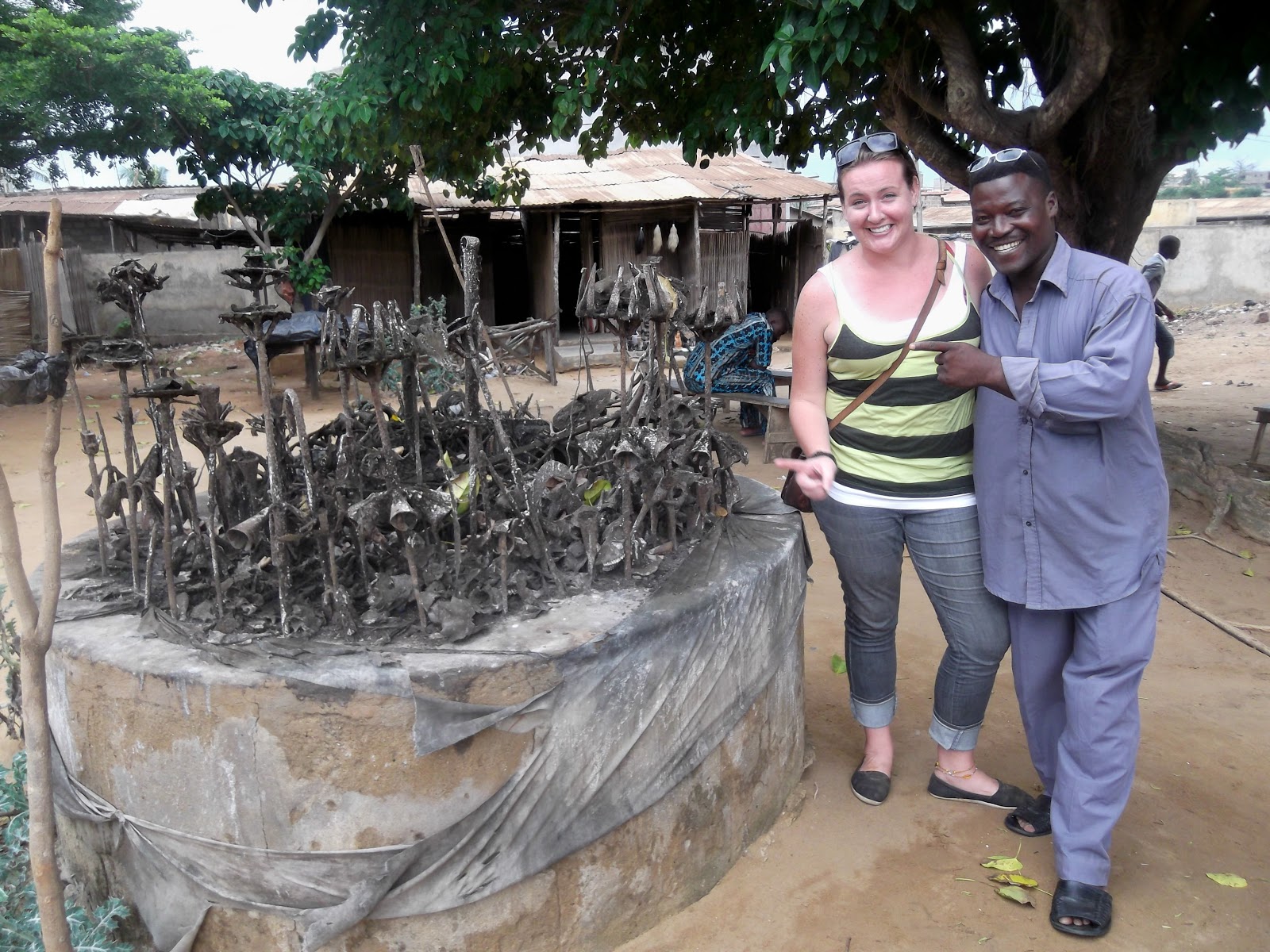
And lastly, the VOODOO MARKET, which it think was my favorite place that we visited in Lomé. This particular market was a voodoo fetish market, which means that they sell charms, totems, and things--for protection while travelling, making someone fall in love, protection from spirits--that sort of thing. There are also fetish priests who sometimes perform ceremonies, to drive away illnesses that are caused by spirits. Now, I will say, that this market was a liiiiiiiiiiiiittle kitschy, most likely because there is more tourist traffic through the capital. But it was still very cool to visit. 

The voodoo itself is an interesting practice though. Depending on what is ailing you, the fetish priest selects from his store of dried and cured animals (cured in a special liquid that keeps them from rotting), which can be burnt as a sacrifice, or ground up, added together, and turned into a medicine, based on the "prescription" from the fetish priest. 

And judging by the display, there are a multitude of different dried animal combinations. They have everything from cheetah to chimp to chameleon. Skulls and skins alike. 


 Below is the area where they hold ceremonies and sacrificial burnings. Our guide was very excited to be in the picture :)

Although the market seemed to be mostly geared towards tourists, there really is a significant portion of the population in Togo, I think about half, that actually practices indigenous religions, like voodoo, some 2.5 million people. It makes me wonder what more genuine voodoo looks like. I really want to travel out into villages, to see...maybe that can be on my third trip to Togo! Now, how can I get in again without a visa...

Until next time! 


Friday, June 8, 2012

Chale Wote

Wow. It’s been over a month since the last update. But really, when you think about it, at this point my life has fallen into the basic routine that everyone follows everywhere—work-eat-sleep-repeat. So unless something breaks me out of that routine, or I have some sort of cultural run-in that makes me look like a fool, I don’t really have anything to write about. Right?

 Don’t get your hopes up though; I don’t look like a fool in this story…well…at least not any more than usual.

 As I get better acclimated with Accra, and all of its neighborhoods, I am starting to find the places that I really enjoy. For example, I love going to Nima, even though it’s very far from where I live, because the majority of the population is Hausa, which is great language practice. It also makes me feel like less of a failure because I really have not learned much of the popular languages in Ghana, like Twi or Ga. And, as an added bonus, if I go there for work, I can rub it in my colleagues faces that understand and they don’t (for once). Sounds spiteful, I know, but around the office they have started pretending to talk about me in Ga, just to get under my skin.

 But my favorite neighborhood, so far at least, is James Town. If Accra was a microcosm of the US, James Town would be NYC. There’s ALWAYS something fun going on. Whether it’s a festival, party, or just an ad hoc gathering, James Town is the neighborhood that never sleeps. It’s also one of the oldest neighborhoods in Accra, and it used to be the main harbor before Tema harbor was constructed, so there is a lot of history to it as well.
 
Let’s do history first!

 As far as the historical sites go, the lighthouse is probably the coolest. Built by the British during their colonial rule, you can go all the way to the top and get a great view of Accra. There are also two forts in the vicinity, James Fort and Ussher fort, but Ussher Fort is the only one that allows visitors. It also happens to be where Kwame Nkrumah, Ghana’s first President, was held captive. There’s been talk of Ussher fort being converted into a museum, but that has yet to happen.


Because James Town used to me the main harbor, there are some remnants of the slave trade as well. Most slaves from Ghana passed through Elmina, which is an island West of Accra, but some slaves were transported from the harbor in James Town. One of my friends has told me that there are underground tunnels connecting Ussher Fort with the harbor, used to transport slaves from the cells to the boats, but I have yet to see any of those. The harbor itself is still very active, not so much for shipping anymore, but for fisherman and crabbers! It’s pretty fun to walk down the breakwater and see all of the fisherman and their giant nets. The boats they use are these little pirogues… I have no idea how they don’t capsize out in the choppy ocean, but somehow they manage.


Now for the festival!

I think the pictures can pretty much speak for themselves, but the Chale Wote Street Art festival is a combination of visual art, fashion, music, and street performance—including some very impressive acrobatics and different types of dance. Needless to say, it was a lot of fun.


Looking forward to seeing everyone in July!! Bye for now.

Wednesday, May 23, 2012